Back in the Saddle: Apollo 7 and the Long Road After the Fire
"is riding like a dream."
Back in the Saddle: Apollo 7 and the Long Road After the Fire
Twenty-one months after tragedy on the pad, a redesigned spacecraft and a veteran commander proved that America could fly again—and gave NASA the confidence to aim for the Moon.
The Weight of Waiting
By the autumn of 1968, the Apollo program had spent nearly two years grounded. On January 27, 1967, a flash fire during a launch-pad test aboard Apollo 1 had killed astronauts Virgil “Gus” Grissom, Edward White, and Roger Chaffee. The accident forced a wholesale redesign of the Command and Service Module. Wiring, materials, the hatch, the oxygen environment—nearly everything that could burn, leak, or fail had to be rethought. For pilots accustomed to returning from an incident report to the cockpit only after the fix is verified, the interval felt endless. NASA would not put humans back on a Saturn stack until engineers and managers were satisfied the Block II CSM could be trusted.
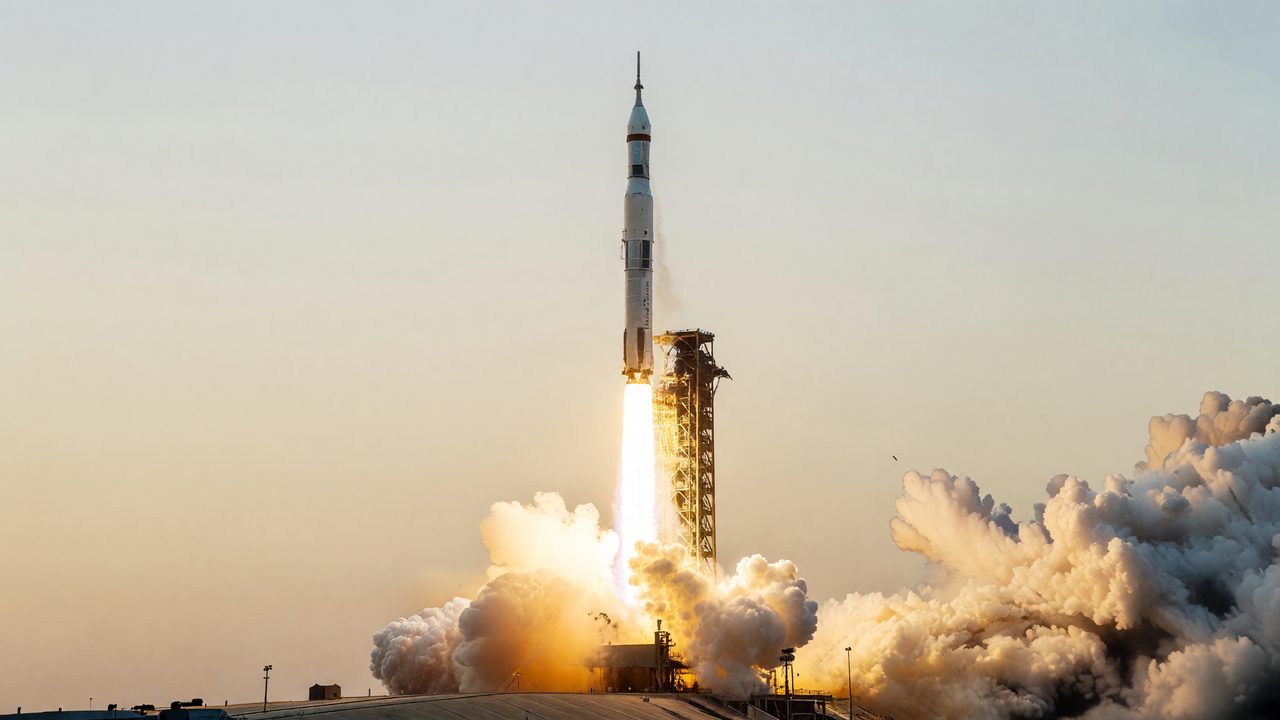
That return came on October 11, 1968, when a Saturn IB rose from Launch Complex 34 at Cape Kennedy Air Force Station. Aboard the redesigned spacecraft rode Commander Walter M. Schirra, Command Module Pilot Donn F. Eisele, and Lunar Module Pilot R. Walter Cunningham. Schirra brought a credential no other astronaut would ever match: he had already flown in Mercury and Gemini, and now he was leading Apollo back into orbit. His crew would not reach the Moon on this flight. Their job was harder in a different way—prove the machine.
A Shakedown Cruise in Earth Orbit
Apollo 7 entered an elliptical orbit roughly 140 by 183 miles above Earth. Across ten days and 163 revolutions, the crew treated the spacecraft as what it was: a flight-test article with human beings inside. They exercised the environmental control and life-support systems that would have to keep lunar crews alive for weeks. They fired the Service Propulsion System and checked guidance and navigation performance under operational conditions. They rehearsed the transposition and docking sequence—maneuvers that would be essential when a Command Module and Lunar Module had to find each other in deep space.
From the commander’s seat, Schirra offered a pilot’s appraisal of the booster that got them there. The Saturn IB, he reported, “is riding like a dream.” For a program that had paid for confidence in blood and calendar time, that kind of plainspoken endorsement mattered.
Windows to the World
The mission also opened a new channel between spacecraft and public. Apollo 7 carried the first live television broadcasts from an American crewed vehicle. Viewers on Earth saw the crew at work inside the Command Module—ordinary human faces in an extraordinary machine. NASA’s official mission history treats those broadcasts as more than public relations. They demonstrated that operational crews could manage additional tasks in flight without compromising the core mission. For student pilots today, that is a familiar tension: fly the airplane first, then handle the radios, the cameras, the passengers, and the checklist items that were not on the syllabus last month.
The Launch Pad That Closed a Chapter
When Apollo 7’s command module splashed down on October 22, 1968, the technical verdict was clear. The Block II CSM had done its job. The mission’s success gave NASA leadership the confidence—just two months later—to send Apollo 8 on a trajectory that would carry Frank Borman, James Lovell, and William Anders around the Moon. The arc of 1968 turned sharply because Apollo 7 had shown that the hardware and the people could perform under pressure.
Apollo 7 also marked the end of an era at the Cape. It was the last human spaceflight to depart from Launch Complex 34, the same pad associated with the Apollo 1 tragedy. The complex was decommissioned in 1969. The spacecraft that flew the mission is preserved at the National Air and Space Museum, a reminder that returning to flight is never merely a calendar event. It is an engineering and human commitment.
Why it matters to you
The legacy of Apollo 7 is the discipline of coming back correctly. Twenty-one months after the fire, NASA did not rush a crew aloft to restore momentum; it flew a redesigned vehicle on a demanding shakedown mission, verified systems methodically, and only then expanded the envelope toward the Moon. That pattern—identify the failure, fix the root cause, test under realistic conditions, document what worked, and earn the next clearance—is the same logic behind modern return-to-service decisions in aviation, from maintenance releases after an AD to airline operations after an incident. Schirra’s crew did not win headlines with a lunar landing. They did something pilots respect more quietly: they made the next flight possible. When you brief an unfamiliar aircraft, run a progressive check ride, or hold your standard until the data supports the next maneuver, you are practicing the same professional habit that put Apollo back in orbit and, two months later, sent Americans to the Moon.