Eight Days to Prove the Moon Was Reachable
"Charlie Brown"
Eight Days to Prove the Moon Was Reachable
Before Armstrong and Aldrin ever touched lunar dust, three veteran astronauts flew every phase of the landing — and stopped just short of the surface itself.
The Rehearsal NASA Could Not Skip
By the spring of 1969, the Apollo program had compressed an extraordinary amount of flight experience into a narrow calendar. Apollo 10, which lifted off on May 18 and splashed down on May 26, was the fourth crewed Apollo launch in seven months. According to NASA mission records, its objective was deliberately blunt: encompass every element of a crewed lunar landing except the landing itself. Commander Thomas P. Stafford, Command Module Pilot John W. Young, and Lunar Module Pilot Eugene A. Cernan would take the first complete Apollo spacecraft — command module, service module, and lunar module together — all the way to the Moon. If anything in that integrated stack failed, the July landing attempt would have to wait.
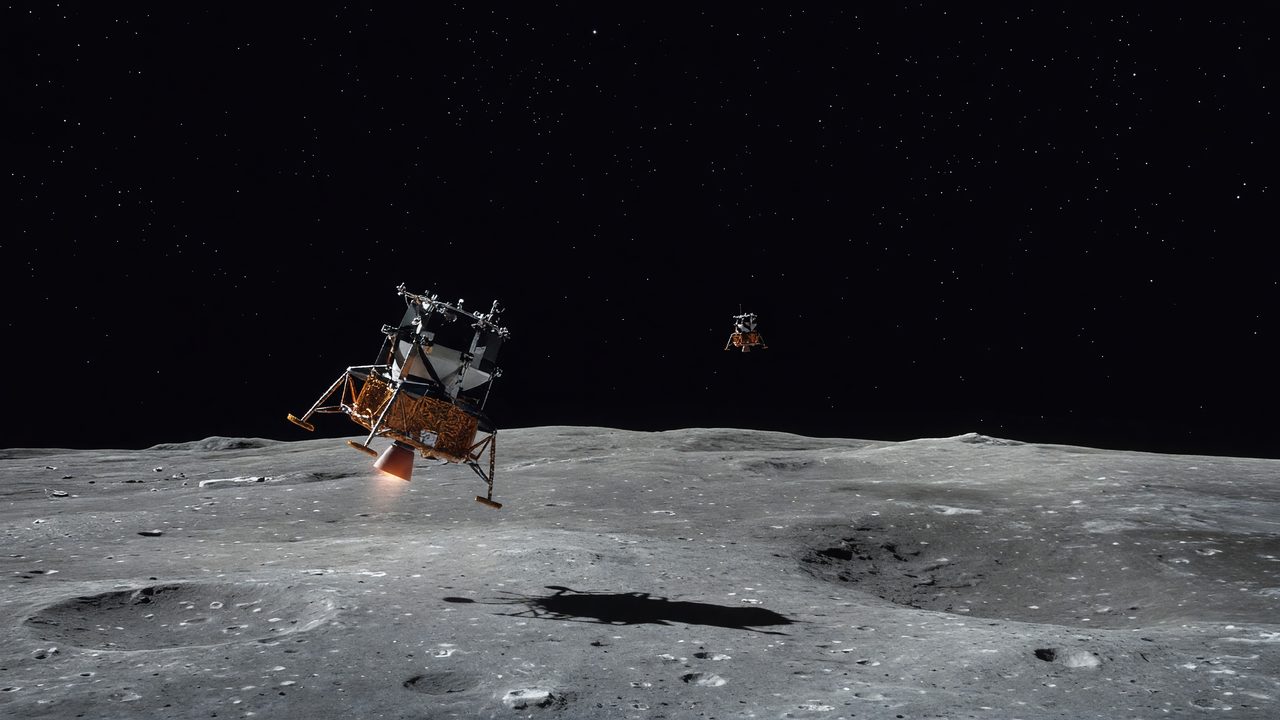
The crew gave their vehicles names that charmed the public and endure in aviation culture to this day. Young would mind the command module Charlie Brown in lunar orbit while Stafford and Cernan rode the lunar module Snoopy down toward the surface. The National Air and Space Museum, which preserves Charlie Brown in its collection, notes that Apollo 10 staged the Apollo 11 mission in full — a dress rehearsal in the most literal sense flight test has ever produced.
Down the Staircase, Not Onto the Porch
After a three-day translunar coast, Apollo 10 slipped behind the Moon and fired its Service Propulsion System engine for lunar orbit insertion — a burn Mission Control could not watch in real time. What followed was thirty-one orbits of the Moon and a descent profile designed to answer one question: would the hardware and procedures Apollo 11 depended on actually work in lunar gravity?
Stafford and Cernan separated Snoopy from Charlie Brown and drove the lunar module along the same kind of trajectory a landing crew would follow. They exercised the descent propulsion system, checked the landing radar, and ran the guidance routines that would soon carry Neil Armstrong and Buzz Aldrin toward the Sea of Tranquility. Over that historic terrain, they simulated the final approach — but held their altitude. NASA's official mission summary records that Snoopy descended to 47,400 feet above the lunar surface, roughly nine miles, the closest any crewed spacecraft had come to the Moon until Apollo 11 landed. From that height the gray plains below were no abstraction. The crew was looking at Armstrong's landing site, verifying the view and the numbers together.
The hardest part of any approach, though, is not going down — it is coming back. Stafford and Cernan jettisoned Snoopy's descent stage, fired the ascent engine, and redocked with Young in Charlie Brown. That sequence was the mission's quiet triumph. A lunar landing meant nothing if the crew could not reliably return to the command module waiting in orbit.
Home Faster Than Any Humans Before
With the lunar phase complete, Apollo 10 fired the Service Propulsion System again for trans-Earth injection, beginning the long fall home. When the command module hit the atmosphere, it did so at 24,791 miles per hour — a reentry velocity that remains, in NASA's accounting, the fastest ever achieved by a crewed spacecraft. The heat shield, navigation, and recovery systems all had to perform under conditions no earlier Earth-orbit mission could duplicate.
Nineteen color television transmissions, totaling nearly six hours, gave audiences on Earth an unprecedented look at spacecraft operations and the Moon itself. Apollo 10 was not merely an engineering exercise watched by technicians. It was a public demonstration that the entire Apollo system — propulsion, guidance, rendezvous, thermal protection, and crew procedures — functioned as an integrated whole.
Why it matters to you
Apollo 10 is the purest example in aerospace history of what pilots today would recognize as a full-dress rehearsal: fly the actual profile, in the actual environment, with the actual equipment, and stop one decision short of the objective. Student pilots practice power-off approaches to the numbers but do not land; instrument trainees fly coupled approaches to minimums and go around; airline crews run LOFT scenarios that stress every system except passenger boarding. The discipline is identical — validate the procedure under real conditions before the day the stakes are irreversible. Stafford, Young, and Cernan proved that separating, descending, navigating, aborting the final segment, ascending, and redocking could be executed by a crew following published guidance, not by improvisation. That is the same standard your checkride examiner, your chief pilot, and your own pre-landing briefing demand: know the profile, trust the instruments, execute the go-around when the mission calls for it, and never confuse "almost" with "done." The Moon landing belonged to Apollo 11. Apollo 10 made sure it was ready.