Molly Brown’s Shakedown: When Two Pilots Learned to Steer in Orbit
"4 hours"
Molly Brown’s Shakedown: When Two Pilots Learned to Steer in Orbit
On March 23, 1965, Gus Grissom and John Young proved that a crewed spacecraft could be flown—not merely ridden—opening the door to rendezvous, docking, and the race to the Moon.
A Name With History
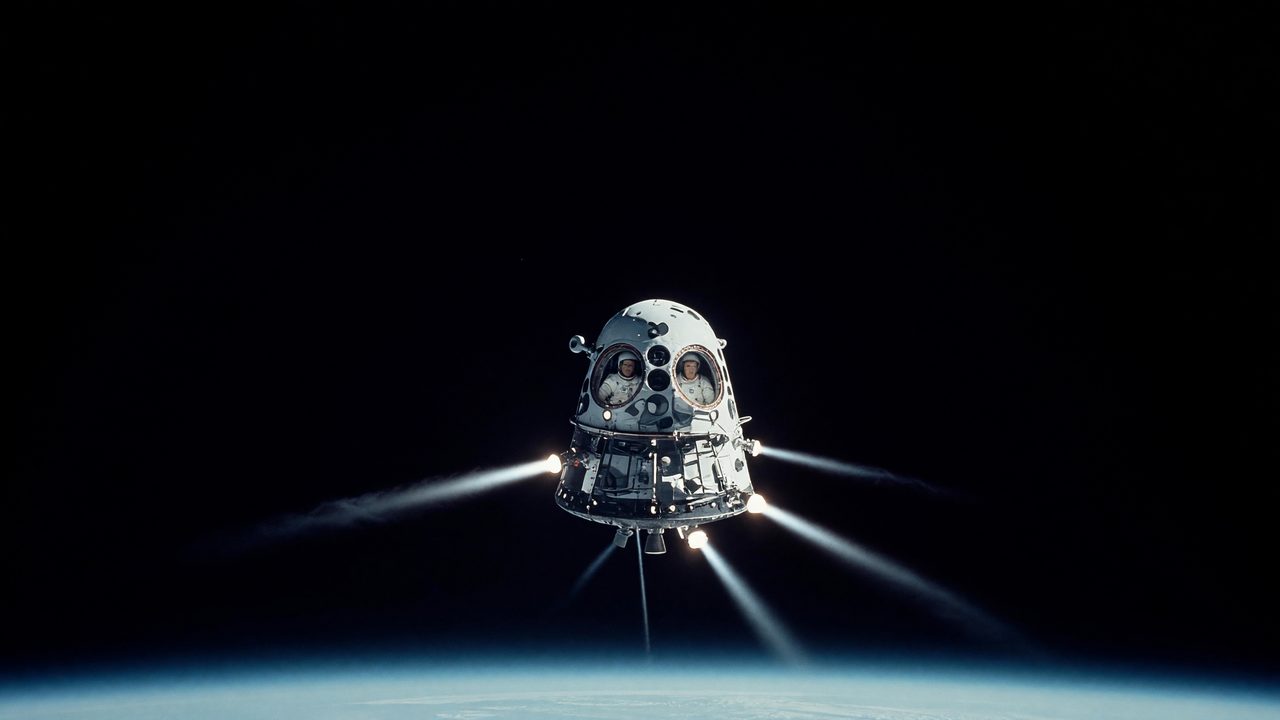
At 9:24 a.m. Eastern on March 23, 1965, a modified Titan II booster cleared Launch Pad 19 at Cape Canaveral and carried America’s first two-person crew into orbit. Veteran Mercury astronaut Virgil I. “Gus” Grissom commanded the flight; John W. Young, making his space debut, served as pilot. Their spacecraft was officially Gemini III, but Grissom had already given it a nickname with a story behind it: Molly Brown.
The reference was pointed. During his Mercury flight aboard Liberty Bell 7 in July 1961, Grissom’s hatch had blown prematurely after splashdown and the capsule sank in the Atlantic. Molly Brown—from the Broadway musical about a woman who famously refused to go down with the ship—was Grissom’s dry way of saying this one would stay afloat. NASA’s public affairs office winced, but the name stuck. It appeared on the mission patch alongside the crew’s names, a wry footnote to a flight that would be remembered for far more serious reasons.
The First Real Spaceflight Test
Mercury had demonstrated that a human could survive launch, weightlessness, and reentry. Gemini had to prove something harder: that a spacecraft could be maneuvered in orbit by its crew. According to NASA’s Gemini III mission summary, this was the program’s first crewed flight and the first American mission in which astronauts fired thrusters to change their trajectory deliberately.
Over three orbits lasting 4 hours, 52 minutes, and 31 seconds, Grissom and Young exercised the Orbital Attitude and Maneuvering System—OAMS—a network of small rockets arranged around the spacecraft. They lowered their orbit, shifted their inclination, and positioned the capsule for a controlled reentry. They became the first humans to alter a spacecraft’s orbital path on purpose. That capability was not academic. Rendezvous and docking—the skills Gemini was built to master—depended entirely on a pilot’s ability to change velocity and altitude with precision. Without orbital maneuvering, the Moon was out of reach.
The flight also exercised the worldwide tracking network, tested reentry guidance algorithms, and validated recovery procedures end to end. As NASA’s History Office noted in its 60th-anniversary retrospective, Gemini III was the bridge between Mercury’s ballistic hops and the complex choreography that Apollo would require.
Sandwich, Splashdown, and a Short Landing
Not everything aboard Molly Brown was in the flight plan. Young had smuggled a corned-beef sandwich into the cabin and offered it to Grissom during the second orbit. Crumbs floated in the weightless environment, and Grissom stowed the sandwich after a few bites. The incident drew a light reprimand in the postflight debrief—unauthorized food could contaminate sensitive equipment—but it also humanized a mission dominated by engineering milestones.
Reentry brought a teachable moment of its own. The capsule touched down in the Atlantic roughly 52 miles short of its target point, the result of lower-than-expected aerodynamic lift during the descent. Grissom and Young were in good condition when recovery forces from the aircraft carrier USS Intrepid reached them. The miss was noted, studied, and folded into the data that would sharpen guidance for subsequent Gemini flights. The spacecraft had worked. The pilots had worked. Gemini was real.
Gemini III also marked a quiet transition in how America ran human spaceflight. It was the last U.S. crewed mission controlled from Cape Canaveral. When Gemini IV launched in June 1965, command shifted permanently to the new Mission Control Center in Houston—a change that would define NASA operations for decades.
Why it matters to you
Every time you practice energy management—trading altitude for airspeed, adjusting your path to hit a fix on schedule, or correcting for unexpected sink on final—you are exercising the same discipline Grissom and Young demonstrated sixty years ago: deliberate control of where your vehicle goes, not passive acceptance of where physics puts you. Orbital mechanics and stick-and-rudder flying look different, but the pilot’s mindset is identical. You define the desired state, you apply controlled inputs, you verify the result against your plan, and you adjust when the outcome diverges. Gemini III was the shakedown cruise that proved a two-person crew could steer in the vacuum above Earth. That lesson—that flight is an active skill, not a ride—remains at the core of every rating you earn.