Night Fire Over the Cape: Apollo 17 and the Last Footprints
"117 seconds"
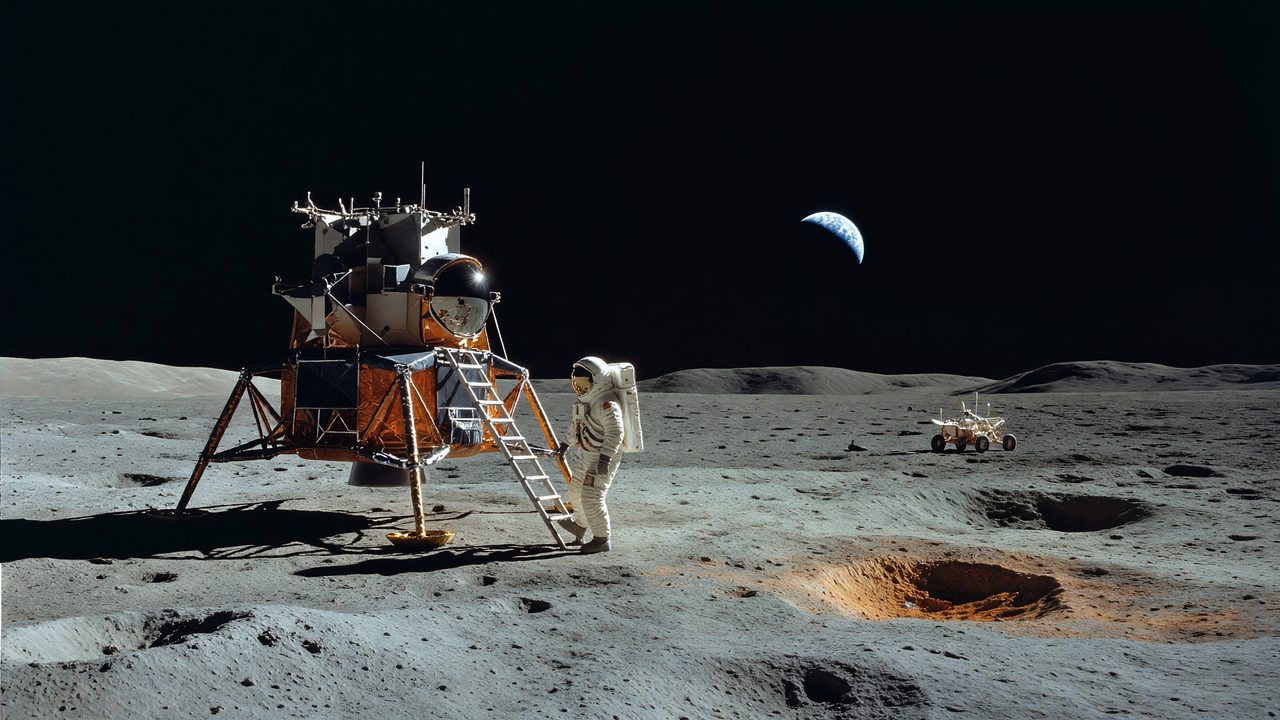
Night Fire Over the Cape: Apollo 17 and the Last Footprints
On a December night in 1972, three astronauts rode a Saturn V into darkness—and two of them would become the last human beings ever to stand on another world.
The Apollo program had already delivered geology lectures written in boot prints across six landing sites when Eugene A. Cernan, Ronald E. Evans, and Harrison H. “Jack” Schmitt climbed aboard their spacecraft. Cernan commanded the mission. Evans would shepherd the command module through lunar orbit while his crewmates worked below. Schmitt, a professional geologist trained as an astronaut, brought something no prior moonwalker possessed: the practiced eye of a field scientist who had spent years reading Earth’s rocks before he ever touched lunar dust.
At 12:33 a.m. Eastern Standard Time on December 7, 1972, their Saturn V lifted from Kennedy Space Center—the only night launch in the entire Apollo series. Flame turned the Florida coast into daylight for a moment, then the stack vanished into black sky trailing a column of fire. For pilots who know the discipline of timing, fuel, and abort geometry, that launch profile was not spectacle alone. It was the opening maneuver of a mission whose margins would be tested all the way to the surface.
Taurus-Littrow and the Narrowest Margin
Four days later, Cernan and Schmitt guided the lunar module Challenger toward the Taurus-Littrow valley—a site chosen for the young volcanic features and highland material it might hold in one traverse. Landing on the Moon demanded the same species of judgment a pilot exercises on final approach: continuous assessment of energy, trajectory, and remaining propellant against an unforgiving surface that offers no go-around in the ordinary sense.
They touched down on December 11 with 117 seconds of descent fuel remaining—more reserve than any previous Apollo landing, yet still a number that underscores how little room lunar operations tolerate. Every second of hover and translation was purchased in training, simulation, and the cold arithmetic of weight and thrust.
Three Days of Fieldwork at 238,000 Miles
Across three extravehicular activities totaling 22 hours and 4 minutes, Cernan and Schmitt worked as a field crew. They drove the Lunar Roving Vehicle 22.3 miles—an off-road expedition across a world without air, without sound carried as pilots know it, where each fender repair and each sample bag was mission-critical maintenance. They returned 243 pounds of lunar material to Earth.
The discovery that rewrote textbooks came at Shorty Crater, where Schmitt’s trained eye recognized orange soil exposed in the rim. Analysis would tie it to volcanic fire-fountain activity on the Moon—a finding that forced geologists to rethink how recently the lunar interior had breathed heat and gas into the surface. Evans, meanwhile, kept his own watch from orbit, conducting scientific observations and later, during the coast home, performing a spacewalk to retrieve film cassettes from the exterior of the command module—a reminder that Apollo crews were never single-track operators but specialists juggling simultaneous duties under deadline.
The Ladder and the Long Silence
On December 14, Cernan became the last man to climb the lunar module ladder. Before he did, his voice carried across the void: “As I take man’s last step from the surface … America’s challenge of today has forged man’s destiny of tomorrow. And, as we leave the Moon at Taurus-Littrow, we leave as we came and, God willing, as we shall return, with peace and hope for all mankind.”
The crew splashed down in the Pacific on December 19. No human has walked on the Moon since. The gap is not an absence of ambition but a measure of how extraordinary the achievement was—an expedition that married propulsion engineering, orbital mechanics, and field science into a single chain of decisions, each link inspected before the next could hold.
Why it matters to you
Apollo 17 is often remembered as an ending, but for pilots in training it is a case study in resource management under stress. Cernan and Schmitt did not “land with plenty of fuel”; they landed with the most reserve any Apollo commander had ever recorded—and that record still amounted to roughly two minutes of descent propellant. That is the lunar equivalent of reaching minimums with your alternate already in mind: you brief the limits, you fly to the numbers, and you never confuse optimism for margin. Schmitt’s work at Shorty Crater mirrors the habit of looking out the window with educated attention—seeing what the instruments alone cannot classify. Evans’s orbital shift and recovery spacewalk echo the modern reality that rated crews operate as integrated systems, not solo performers. The last footprints on the Moon were not left by men who got lucky on a dark December night. They were left by aviators and scientists who had rehearsed the failure modes until the extraordinary read, on the tape, like procedure—and that discipline, forged in America’s last lunar challenge, remains the standard every pilot carries into the cockpit today.