The Last Reentry
"307 days"
The Last Reentry
On a sweltering July morning in 2011, nearly a million spectators crowded Florida’s Space Coast to watch a winged spacecraft lift off one final time—and to mark the end of thirty years of American reusable spaceflight.
A Crowd at the Cape
The heat on the morning of 8 July 2011 was oppressive even by Florida standards, yet the roads along the Indian River and the beaches of Cape Canaveral filled with spectators anyway. NASA’s news release that day described a nation gathering to witness the beginning of its final Space Shuttle mission. At 11:29 a.m. EDT, Space Shuttle Atlantis cleared Launch Complex 39A on mission STS-135—the 135th and last flight of a program that had defined human spaceflight since April 1981.
Commander Christopher Ferguson, Pilot Douglas Hurley, and Mission Specialists Sandra Magnus and Rex Walheim rode a vehicle whose silhouette had become as familiar as any airliner’s, yet whose flight regime belonged to no category pilots encounter in ordinary cockpits. According to NASA’s STS-135 mission page, the crew’s primary cargo was the Raffaello multi-purpose logistics module, packed with more than 8,000 pounds of food, equipment, and spare parts destined for the International Space Station. The station would soon depend on other vehicles for resupply; this flight was designed to stock its shelves before the shuttles stood down.
Work in Orbit
For twelve days, eighteen hours, twenty-seven minutes, and fifty-six seconds—nearly thirteen days by any human measure—Atlantis and its crew kept station with the orbiting laboratory. NASA’s mission press kit framed STS-135 as both a logistics run and a technology demonstration. Magnus and Walheim, working with station astronauts, conducted the Robotic Refueling Mission, testing tools and techniques that might one day allow satellites in orbit to be serviced robotically rather than written off when propellant ran low. The crew also removed a failed ammonia pump module from the station’s cooling system and stowed it in the payload bay for return to Earth, where engineers could dissect the fault and improve designs for hardware that cannot simply be swapped at a maintenance hangar.
These were not dramatic firsts in the sense of a lunar landing or a spacewalk debut. They were the disciplined, repetitive labor that keeps complex systems alive—exactly the kind of work the shuttle had performed across three decades while assembling the station itself.
Wheels Stop on Runway 15
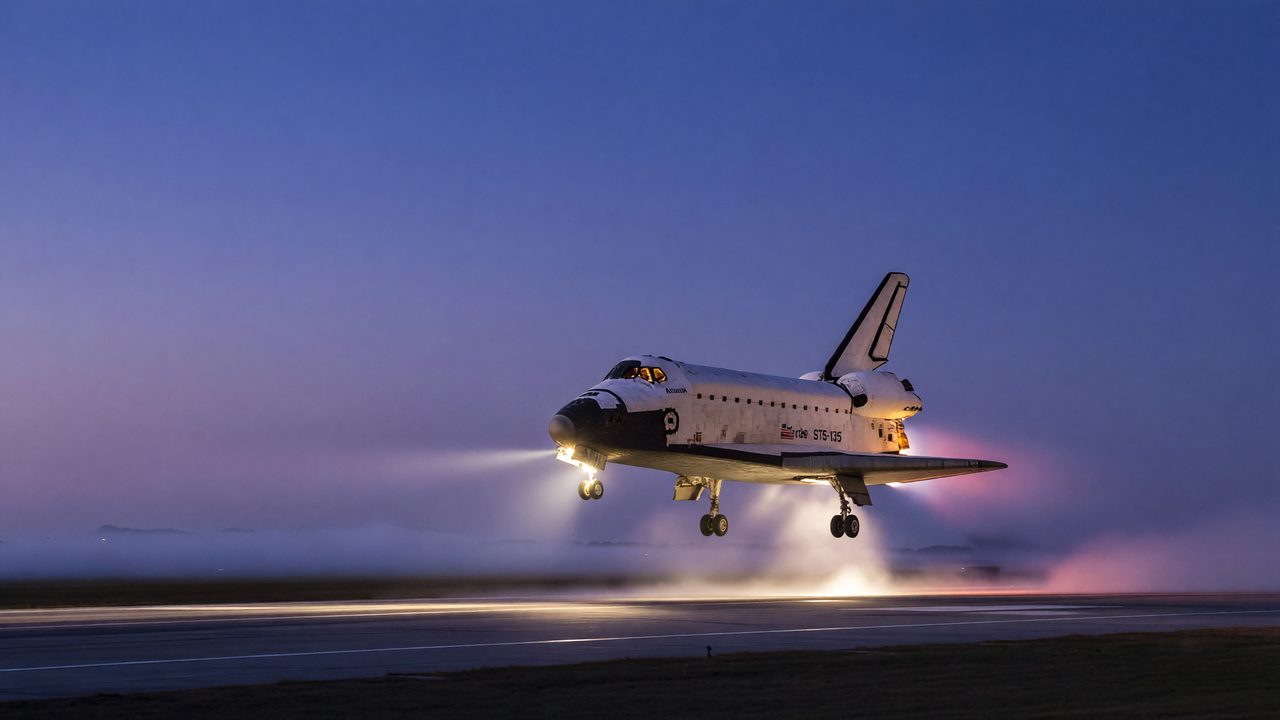
The return came in darkness. NASA announced beforehand that Atlantis was scheduled to land at Kennedy Space Center on the morning of 21 July, and the STS-135 mission page records what followed: touchdown on Runway 15 at the Shuttle Landing Facility at 5:57 a.m. EDT. It was the twenty-sixth night landing in shuttle program history—the twentieth at Kennedy—and it closed a chapter written in fire and friction.
When Ferguson brought the orbiter to a stop, the numbers told their own story. Across thirty-three flights, Atlantis had accumulated 307 days in space and traveled nearly 126 million miles. The broader shuttle program had carried 833 crew members into orbit, deployed satellites, repaired the Hubble Space Telescope, and built the largest structure ever assembled off the planet. STS-135 did not end American human spaceflight; astronauts would continue aboard Soyuz spacecraft and, eventually, commercial crew vehicles. What ended was a particular machine—a delta-winged glider launched like a rocket and flown home like an aircraft with no go-around option.
A Machine Between Worlds
The Space Shuttle occupied a category no pilot’s certificate fully describes. Its launch phase demanded the precision of instrument flight under rules written for rockets; its reentry and landing demanded energy management, approach stabilization, and crew coordination familiar to anyone who has flown a high-performance aircraft on a dark morning to a narrow runway. Ferguson and Hurley had both come from military aviation. Magnus and Walheim brought engineering and spacewalking expertise. Together they embodied the shuttle era’s central lesson: that the hardest flights are not solo performances but team efforts, where checklists, callouts, and contingency plans matter as much as stick-and-rudder skill.
Why it matters to you
The legacy of that hot July morning on the Florida coast reaches into every cockpit where pilots train today. STS-135 was a logistics mission flown to a hard deadline with no backup vehicle waiting on the pad—a reminder that professional airmanship is often less about spectacle than about executing a plan under pressure, managing energy and configuration through phases no single rating covers, and trusting crew resource management when the margin for error is thin. Night landings at Kennedy demanded the same discipline you practice on a dark approach to a short runway: stabilized profiles, clear roles, and the humility to let procedure carry you when instinct alone is not enough. The shuttle program is gone, but its final crew left behind a standard worth holding in any aircraft: prepare meticulously, fly the mission you briefed, and bring the machine home so the next chapter can begin.