Three Men, One Cabin, and a Lesson Written in Fire
"At 6:31 p"
Three Men, One Cabin, and a Lesson Written in Fire
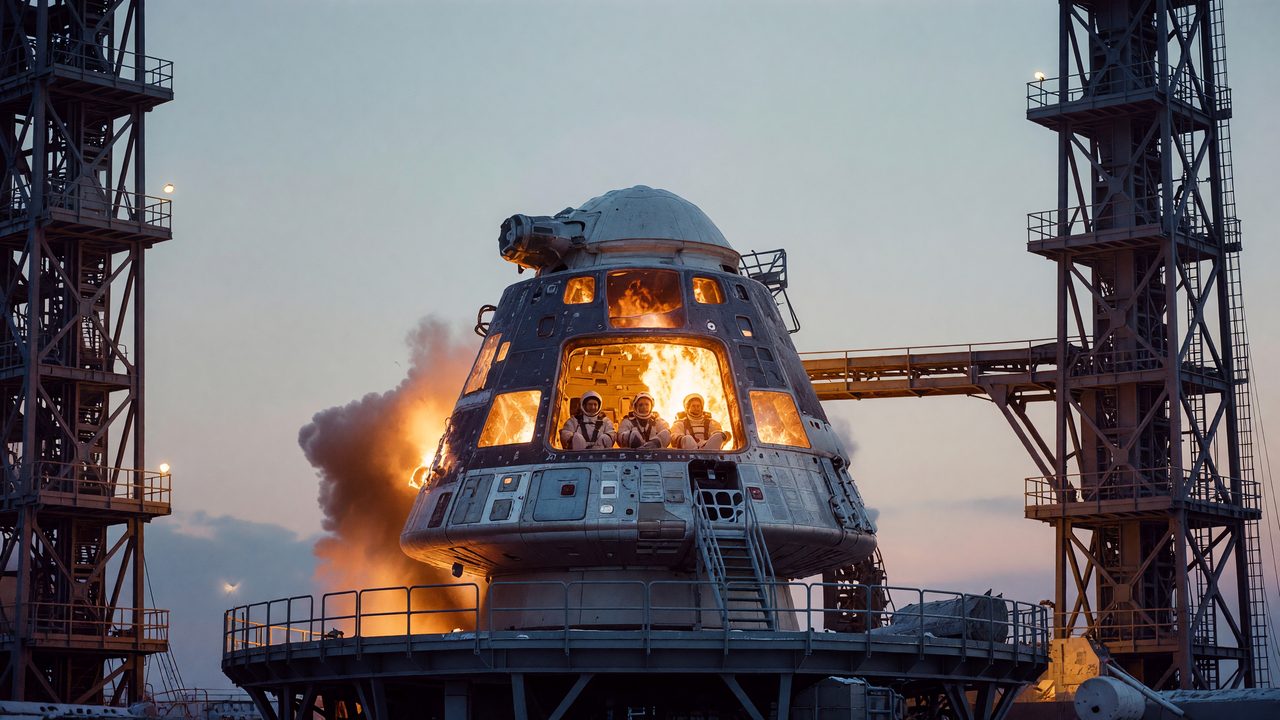
On January 27, 1967, America’s first Apollo crew died not in orbit but on the launch pad—during a routine test that exposed how quickly engineering confidence can outrun safety.
The Test That Was Supposed to Be Ordinary
Cape Kennedy’s Launch Complex 34 had hosted triumph before, but the work scheduled for Friday, January 27, 1967, was deliberately earthbound. Apollo Command Module 012 sat atop its Saturn IB stack while engineers ran a full “plugs-out” test—a simulated countdown with the spacecraft operating on its own internal power, as it would on launch day. The three men inside were not tourists. They were the flight crew assigned to the first manned Apollo mission.
Lieutenant Colonel Virgil I. “Gus” Grissom had already flown Mercury and Gemini. Lieutenant Colonel Edward H. White II had opened America’s first spacewalk during Gemini 4. Lieutenant Commander Roger B. Chaffee was preparing for his first flight. Veterans and rookie alike, they were strapped into couches in a cabin pressurized with pure oxygen at roughly sea-level pressure—a configuration chosen to simplify spacecraft design but one that would prove catastrophically unforgiving.
According to NASA’s official chronology of the event, trouble announced itself in a way no countdown clock could measure. At 6:31 p.m. EST, a flash fire swept through the command module. Fed by the oxygen-rich atmosphere and by combustible materials inside the cabin, the blaze spread with terrifying speed. The crew reported a fire over the communications loop. Then the transmission fractured into chaos.
Seconds Against an Inward-Opening Hatch
What followed unfolded in a timeframe measured in heartbeats, not minutes. The Apollo 204 Review Board, in its report of April 5, 1967, examined how design choices compounded the emergency. The command module hatch opened inward, a arrangement that made sense for holding pressure in the vacuum of space but that worked against the crew on the pad. Internal pressure from the fire, heat, and smoke pressed the hatch closed even as the astronauts fought to release its multiple latches and locking mechanisms.
Ground teams raced toward the white room at the end of the access arm. They faced their own obstacles: dense smoke, a hatch that could not be opened quickly from the outside, and an environment that had turned lethal almost at once. By the time rescuers reached the crew, it was too late. Grissom, White, and Chaffee had perished inside the spacecraft they had been testing.
The mission designation would be changed in the aftermath. What the program had called Apollo 1—what had been AS-204 in planning documents—became known to history as the Apollo 1 tragedy, a name that carries both grief and obligation.
What the Investigations Found
NASA convened the Apollo 204 Review Board to determine what had failed and why. The board’s findings, preserved in the NASA Historical Reference Collection, pointed not to a single broken wire or one careless act, but to a chain of conditions: the pure-oxygen environment at cabin pressure, materials inside the spacecraft that could burn vigorously in such an atmosphere, electrical wiring and equipment vulnerabilities, and hatch design that impeded emergency egress during a pad emergency.
Congress pressed its own inquiry. The U.S. Senate Committee on Aeronautical and Space Sciences issued its report in January 1968, adding legislative weight to the technical record. Together, the government and agency investigations made clear that the fire was not an unforeseeable bolt from the blue. It was the product of assumptions that had hardened into routine—assumptions about oxygen, about flammability, about how much time a crew would have if something went wrong.
The program did not stop. It changed. Apollo’s command module was redesigned. Materials were scrutinized. Oxygen procedures were revised. Hatches were rebuilt for faster escape. The path to the Moon would now pass through the lessons of Launch Complex 34.
A Memorial on the Pad
Today, NASA’s official mission page for Apollo 1 honors the crew not as abstractions but as working astronauts who died in service to exploration. Their names are carried forward on mission patches, in annual remembrances, and in the quiet discipline of engineers and flight crews who still ask the uncomfortable question before every test: What are we assuming is safe—and what if we are wrong?
The fire lasted only seconds. Its influence has lasted generations.
Why it matters to you
Every pilot who has run a checklist, briefed a cabin fire, or questioned a “we’ve always done it this way” procedure is training in the shadow of January 27, 1967. Modern aviation safety culture—crew resource management, non-punitive reporting, rigorous hazard analysis, and the insistence that egress and emergency access be designed for the worst case, not the nominal one—did not appear fully formed. It was purchased, in part, with hard lessons from spacecraft and aircraft programs that learned too late how fast fire moves in an oxygen-rich environment. When you treat a ground test as seriously as a flight, when you speak up about combustible materials near ignition sources, when you refuse to let schedule pressure normalize risk, you are applying a legacy written in a Florida evening half a century ago. The Apollo 1 crew never left the pad. The standard they helped impose on everyone who flies afterward did.