Three Stages to the Moon: The Saturn V at Full Throttle
"363 feet"
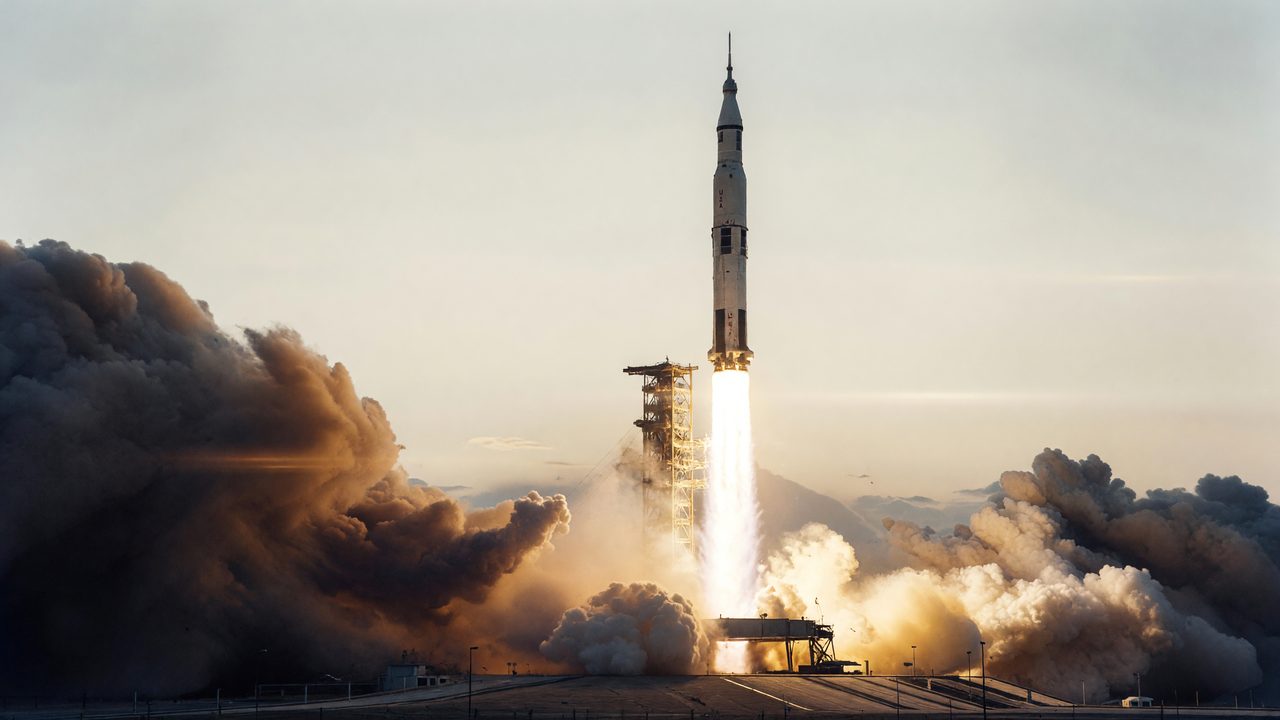
Three Stages to the Moon: The Saturn V at Full Throttle
At 363 feet and 6.2 million pounds, the rocket that answered Kennedy’s challenge still defines what “maximum performance” means—and what disciplined flight operations look like under impossible margins.
On the morning of November 9, 1967, Launch Complex 39A at Kennedy Space Center shuddered as five Rocketdyne F-1 engines roared to life. The vehicle that rose from the pad was not an airplane, yet every rated pilot recognizes the problem it was built to solve: moving a useful payload across an enormous energy gradient with margin enough to survive the trip and come home. Designed under the technical leadership of Wernher von Braun at NASA’s Marshall Space Flight Center in Huntsville, Alabama, the Saturn V was engineered for one mission profile—Apollo—and at roughly 7.5 million pounds of liftoff thrust, it defined the era—though NASA’s Space Launch System and SpaceX’s Starship/Super Heavy have since exceeded that output on successful flights.
Scale is the first lesson. The Saturn V stood 363 feet tall, roughly 60 feet higher than the Statue of Liberty, and weighed 6.2 million pounds at liftoff. Its first stage alone produced 7.5 million pounds of thrust—NASA’s own comparisons put that near the output of 85 Hoover Dams running at once. Three contractors built the stages: Boeing’s S-IC first stage, North American Aviation’s S-II second stage, and Douglas Aircraft Company’s S-IVB third stage, with Rocketdyne supplying the engines that turned kerosene and liquid oxygen into controlled thunder. The stack was not a single machine so much as a coordinated sequence of machines, each shedding mass and changing the flight regime as altitude and velocity climbed.
For pilots, the Saturn V’s flight profile reads like an extreme case study in energy management and systems monitoring. Stage separation, engine-out considerations, guidance updates, and structural loads all had to be managed in a narrow timeline where there was no go-around. NASA’s Launch Vehicles: Saturn V documentation in the Apollo Lunar Surface Journal describes how each stage’s propulsion, tankage, and avionics were integrated into a single ascent solution—one where failure modes had to be anticipated long before the hold-down posts released.
The flight record is the proof. Of 13 Saturn V launches, 12 were complete successes. The exception was Apollo 6, an April 1968 uncrewed test whose partial failure nonetheless returned invaluable data. NASA’s History Office records that longitudinal oscillations—“pogo”—and other structural vibration issues appeared during ascent. Engineers used Apollo 6’s telemetry to correct those problems before Apollo 8 carried the first crew into lunar orbit. That is the operational culture pilots train for today: a flight that does not achieve every objective can still advance safety if the data are captured, analyzed, and folded into the next briefing.
After Apollo 11’s July 1969 landing, the Saturn V did not retire—it became the nation’s lunar commuter and then its heaviest lifter in Earth orbit. The same booster family launched every Apollo lunar mission and, in May 1973, placed the Skylab space station into orbit. Smithsonian’s Air & Space account of how American factories, railways, and waterways moved Saturn stages underscores another aviation parallel: great performance is never only a cockpit story. Logistics, manufacturing tolerances, quality control, and cross-country transport constraints shaped what could launch on schedule.
No rocket of comparable payload capacity has flown since the last Saturn V left the pad. That absence is itself a historical marker. The vehicle demonstrated that President Kennedy’s 1961 challenge—landing astronauts on the Moon and returning them safely—was not rhetoric but an engineering contract the United States could fulfill. For a generation of engineers, test conductors, and astronauts, the Saturn V was the physical proof that requirements written in political speeches could be translated into procedures, checklists, and hardware that worked when the count reached zero.
Why it matters to you
The Saturn V will never appear on your sectional chart, but the disciplines that built it are embedded in the aircraft you fly. Marshall’s systems-engineering approach—define the mission, allocate margins, test the worst case, feed lessons back into the next flight—mirrors how modern training treats performance planning, weight-and-balance limits, and emergency procedures. When you calculate density altitude, brief a crosswind landing, or study why a manufacturer issued an airworthiness directive after a single anomalous flight, you are practicing the same habit Apollo 6 institutionalized: treat every outcome as data, and let the next crew benefit. The Moon rocket’s lesson is not nostalgia. It is that precision, documentation, and honest post-flight analysis are how impossible goals become flight plans you can brief—and then fly.