Twenty-Seven Minutes of Triumph, Then the Sky Began to Spin
"101 minutes"
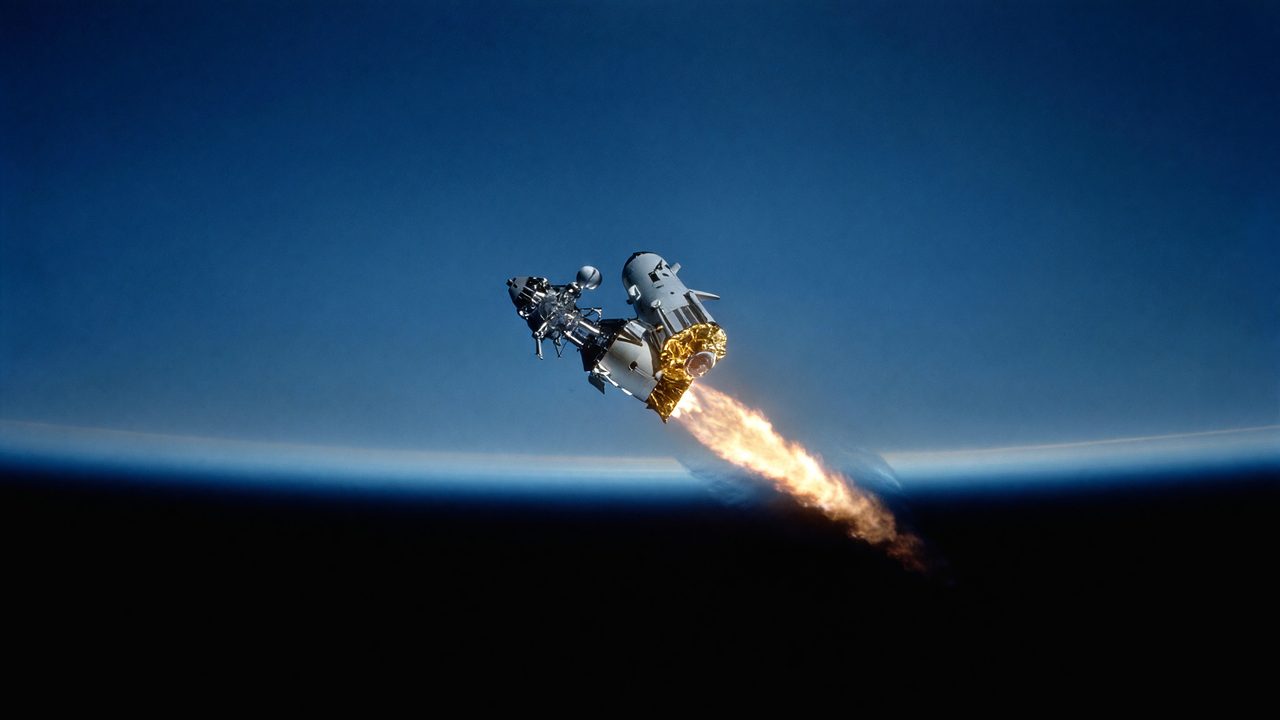
Twenty-Seven Minutes of Triumph, Then the Sky Began to Spin
On March 16, 1966, Neil Armstrong and David Scott proved that two spacecraft could meet in orbit — then fought a stuck thruster at nearly one revolution per second to bring Gemini VIII home alive.
The Gemini program was NASA's proving ground for the skills Apollo would demand: long-duration flight, spacewalks, and the delicate choreography of orbital rendezvous. By early 1966, American crews had already flown formation with another spacecraft — Wally Schirra and Tom Stafford had closed to within feet of Gemini VII the previous December — but no one had yet joined two vehicles into a single, mechanically linked stack. That was Gemini VIII's assignment. Command pilot Neil A. Armstrong, already seasoned from seven X-15 rocket-plane flights between December 1960 and July 1962, reaching a peak altitude of about 207,500 feet and a top speed of Mach 5.74, though never above the 50-mile threshold, would fly the active vehicle. Pilot David R. Scott, a future Apollo moonwalker, would handle systems and, if all went well, conduct the program's second planned extravehicular activity.
Launch day unfolded in two acts separated by a little more than an hour and a half. At 10:00 a.m. Eastern Standard Time, an Atlas booster placed the Agena target vehicle into orbit from Cape Kennedy's Pad 14. One hundred one minutes later, Armstrong and Scott rode a Titan II off Pad 19. Their flight plan called for an M=4 rendezvous — catching the Agena in roughly four orbits, about six hours after liftoff. According to NASA's mission summary, the chase proceeded without drama. On the afternoon of March 16, Armstrong guided Gemini VIII's nose into the Agena docking collar. For the first time in history, a crewed spacecraft docked with another in Earth orbit as Armstrong and Scott linked with the uncrewed Agena target vehicle.
The achievement held for twenty-seven minutes. Then, as the Agena executed a planned 90-degree maneuver, Scott noticed an unwanted roll. Armstrong countered with the Orbital Attitude and Maneuvering System (OAMS) thrusters on Gemini's white adapter section. The roll stopped — and immediately restarted, worsening into a combined roll and tumble. The crew was on the far side of the planet, out of radio contact with Mission Control. Instrument readings grew difficult to read as gyration accelerated. Fearing the Agena might break apart, Scott reset the target vehicle to ground control and undocked. The logic seemed sound. It was wrong.
Separated from the Agena, Gemini VIII spun harder, not easier. The fault was not the target vehicle but Gemini itself: OAMS roll thruster number 8 had short-circuited, its valves stuck open, propellants igniting continuously on contact. With no way to isolate individual OAMS jets, Armstrong made the call that saved the mission and the crew. He shut down the entire OAMS and activated the Reentry Control System — sixteen small thrusters ringing the spacecraft nose, reserved for the critical phase after retrofire. Burning nearly three-quarters of that precious RCS fuel, he arrested the spin as rates approached one revolution per second, a rate at which blackout and loss of consciousness were imminent.
Mission rules were unambiguous: firing the RCS for an in-flight emergency mandated an immediate return. Armstrong understood the cost — Scott's planned spacewalk cancelled, a three-day flight cut to hours — and accepted it. When contact resumed via a Pacific tracking ship, Houston concurred. The crew stayed one additional orbit to reach a contingency splashdown zone, then reentered over the western Pacific. Gemini VIII landed after 10 hours, 41 minutes, and 26 seconds aloft, roughly 620 miles south of Yokosuka, Japan, where pararescue divers from a U.S. Air Force C-54 soon reached the spacecraft. Three hours later, the destroyer USS Leonard F. Mason recovered Armstrong and Scott.
Post-flight analysis confirmed the short-circuited thruster. Because the adapter module was jettisoned before reentry, engineers reconstructed the failure from telemetry rather than hardware. Gemini IX and later missions gained circuit breakers to isolate thruster groups — a direct lesson written in fuel and fright. Scott's lost EVA meant the next spacewalk, on Gemini IX, would proceed with less operational experience than planners had hoped. Yet the mission's central objective stood proven: orbital docking worked. The technique that would later join Apollo command and lunar modules in lunar orbit had passed its first live test.
Armstrong's composure under escalating rates — reading systems when the cockpit itself seemed to revolve — was not luck. It was the product of years spent at the edge of the atmosphere in the X-15, where fuel margins, control authority, and split-second systems decisions meant the difference between a data point and a casualty. That same disciplined knowledge would surface again in July 1969, when he guided Apollo 11's lunar module Eagle to the Sea of Tranquility with seconds of descent fuel remaining.
Why it matters to you
Gemini VIII is a case study in the aviator's hierarchy every flight instructor still teaches: aviate first, then navigate, then communicate. Armstrong did not wait for Houston to diagnose a thruster he could not individually shut off. He identified the real aircraft — in this case, his own spacecraft — isolated the failing system, committed a backup he knew he could not reuse, and stopped the rotation before physiology became the limiting factor. Modern upset-recovery training, electrical-failure drills, and the emphasis on deep aircraft-systems knowledge all echo that afternoon in orbit. You may never dock with an Agena or burn a quarter of your reentry fuel stopping a spin, but the principle holds: when indications conflict and the ride deteriorates, the pilot who understands what each switch actually controls — and what each resource costs to spend — is the pilot who brings the machine home. Armstrong and Scott did exactly that, sixty years ago this March.