When Machines Need Surgeons
"35 hours"
When Machines Need Surgeons
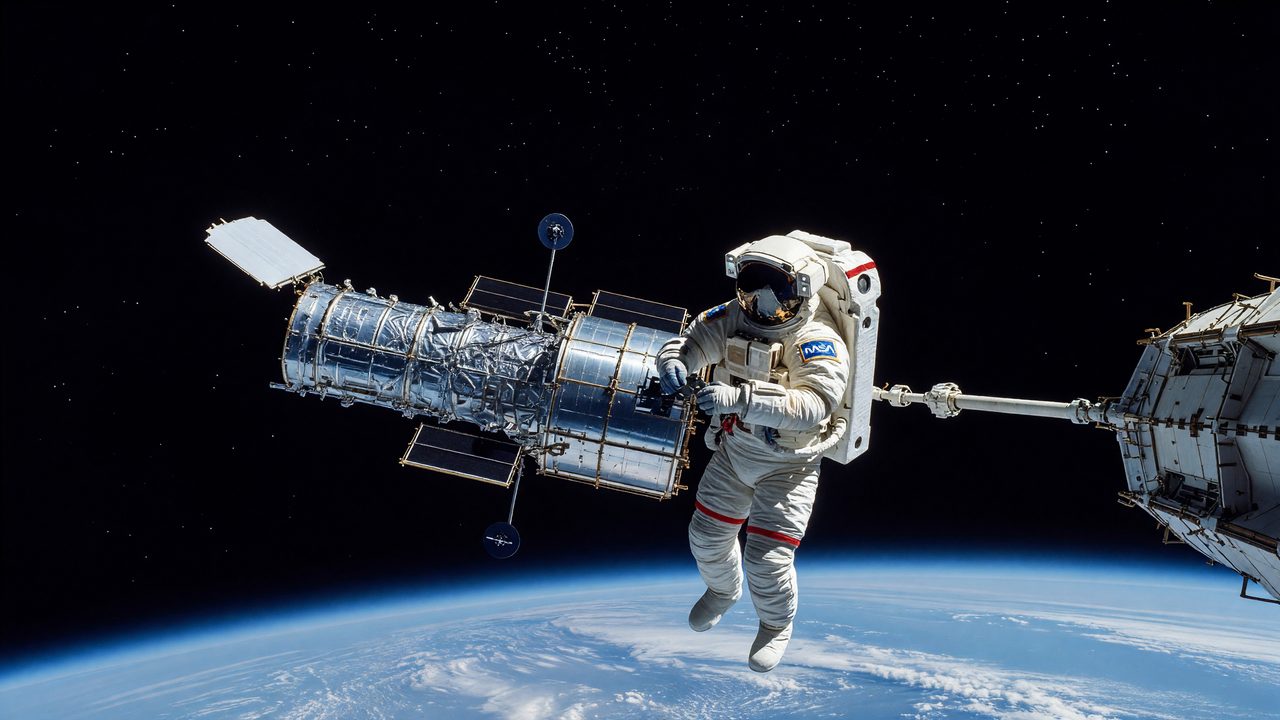
On 2 December 1993, seven astronauts climbed into Space Shuttle Endeavour to perform orbital surgery on a billion-dollar telescope — and proved that human skill could redeem a flaw no ground test had caught.
The Hubble Space Telescope had left Earth aboard Discovery in April 1990 carrying the hopes of astronomers and the prestige of a nation. When its first images arrived, they were not the crystalline windows on the universe that engineers had promised. Stars bloomed into fuzzy halos. Galaxies smeared at the edges. The culprit was brutally small and impossibly large at once: the primary mirror had been polished to the wrong shape, off by roughly two-thousandths of a millimeter — a human hair is thicker — yet enough to scatter light across the optics and turn discovery into disappointment.
NASA faced a choice that would have been unthinkable a decade earlier. Hubble could not be retrieved to a hangar. There was no runway in low Earth orbit. The agency would have to send mechanics, electricians, and optical specialists into vacuum, working hand-over-hand on hardware never designed for casual disassembly. Servicing Mission 1, designated STS-61, became the most ambitious repair flight ever attempted.
At 4:27 a.m. EST on 2 December 1993, Endeavour lifted from Launch Pad 39B at Kennedy Space Center. Commander Richard O. Covey and Pilot Kenneth D. Bowersox flew the orbiter while five mission specialists — Kathryn C. Thornton, European Space Agency astronaut Claude Nicollier, Jeffrey A. Hoffman, F. Story Musgrave, and Thomas D. Akers — prepared for the work ahead. Over eleven days in space, the crew would conduct five consecutive extravehicular activities, a record pace totaling 35 hours and 28 minutes outside the spacecraft.
Each spacewalk addressed a distinct failure mode. The solar arrays, which had been jittering and threatening stability, were replaced. The Wide Field/Planetary Camera II was installed to take advantage of corrected light paths. Most critically, the crew placed the Corrective Optics Space Telescope Axial Replacement — COSTAR — a bundle of mirrors that intercepted and refocused light before it reached Hubble’s other instruments, compensating for the primary mirror’s error without replacing the mirror itself. Astronauts also swapped rate-sensing units and electronic control boxes, restoring attitude control and command pathways that ground controllers needed for precise pointing.
The work demanded choreography as exacting as any cockpit procedure. Tools floated unless tethered. Gloves reduced tactile feedback to a blunt approximation of touch. Thermal swings punished both human and hardware. Musgrave, Hoffman, Thornton, Akers, and Nicollier rotated through the EVA schedule while Covey and Bowersox held Endeavour steady and the cabin crew managed power, communications, and the endless stream of checklists that governed every bolt turned in darkness. When a task ran long, the next shifted. When a latch resisted, engineers on the ground and astronauts on the end of a robotic arm improvised within the narrow margins their training allowed.
The proof came not in the hangar but in the pixels. As Hubble’s newly sharpened eye opened, images resolved into the sharp detail astronomers had waited years to see. A manufacturing error that no amount of ground testing had fully exposed had been corrected by human hands wearing pressurized suits, working at 17,500 miles per hour.
Endeavour landed at Kennedy Space Center on 13 December 1993. STS-61 did more than rescue a national scientific asset. It demonstrated that complex machines in orbit could be maintained, upgraded, and healed — that the frontier was not only a place to visit but a workshop where trained crews could execute repairs no robot of the era could match.
Why it matters to you
The legacy of STS-61 lives in every cockpit where pilots train to fly procedures they hope never to need. Hubble’s blur was a latent defect — invisible until the system was operated in its real environment, much like a subtle instrument error or a procedure gap that only appears under workload. The servicing crew responded with layered contingencies, disciplined cross-checks, and crew resource management across seven specialists operating on independent timelines. They could not pull over; they could not abort to a repair facility. They had to verify each step, communicate deviations clearly, and trust that training written on Earth would hold in vacuum. Modern pilot education stresses the same architecture: know your limitations, brief the abnormal, execute methodically, and confirm the outcome with independent evidence. When you practice an emergency approach or run a challenge-response checklist with a copilot, you are rehearsing the same principle that sharpened Hubble — that precision, humility, and teamwork can recover a mission when hardware alone cannot.