When the Cold Said Wait, and the Clock Said Go
"The morning of 28 January 1986 was bitterly cold at Kenne..."
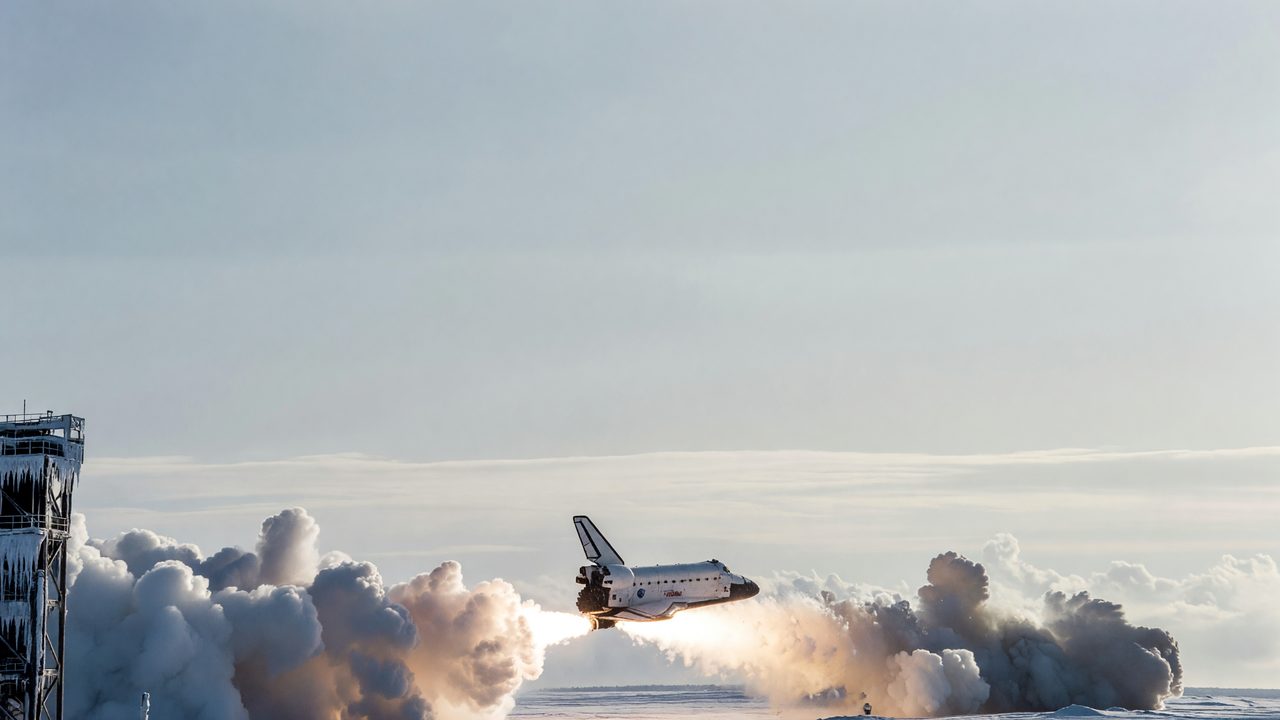
When the Cold Said Wait, and the Clock Said Go
On a Florida morning when icicles hung from the launch tower, seven Americans rode a flame into history—and into a lesson every aviator still carries.
The Space Shuttle was sold to the public as routine. By January 1986, twenty-four successful missions had trained a nation to watch liftoff the way it watched a departing airliner: impressive, yes, but expected. Mission 51-L was meant to widen that familiarity. A teacher from Concord, New Hampshire, would speak to classrooms from orbit. A satellite would be deployed. The flight manifest read like proof that spaceflight had joined the ordinary rhythms of American ambition.
The morning of 28 January 1986 refused that narrative. Bitter cold settled over Kennedy Space Center. Ice clung to the launch structure. Technicians and engineers had spent the hours before launch debating what the temperature meant for the vehicle waiting on Pad 39B. The decision, in the end, was to proceed.
At 11:38 a.m. Eastern Standard Time, Space Shuttle Challenger rose on a pillar of fire, carrying seven people into a sky that had never felt so hostile. Commander Francis R. Scobee and Pilot Michael J. Smith sat forward in the cockpit. Behind them rode Mission Specialists Ronald McNair, Ellison Onizuka, and Judith Resnik, Payload Specialist Gregory Jarvis, and Teacher-in-Space Christa McAuliffe—the first ordinary citizen chosen to fly as NASA’s emissary to the nation’s students.
Seventy-three seconds after liftoff, the mission ended. Television viewers saw the familiar shape of the orbiter torn apart in a blossoming cloud of vapor and flame, the violent burn of hydrogen and oxygen that marked the destruction of the external tank and the structural failure of the stack. The solid rocket boosters, still burning, corkscrewed away until range safety destroyed them. To millions watching live, including schoolchildren gathered for McAuliffe’s lesson, the scene was incomprehensible. The shuttle program had not merely failed. It had failed on stage.
President Ronald Reagan appointed an independent investigative body chaired by former Secretary of State William P. Rogers—the Rogers Commission, as it would forever be known. Its mandate was not condolence but diagnosis. Engineers reconstructed telemetry, recovered wreckage from the Atlantic floor, and replayed the decisions that preceded launch.
The Commission’s findings, delivered to the President on 6 June 1986 and preserved in Volume 1 of the Report of the Presidential Commission on the Space Shuttle Challenger Accident (NASA Technical Reports Server), identified a physical cause and a human one. The physical failure was the breach of the pressure seal in the aft field joint of the right Solid Rocket Motor. Hot combustion gases escaped through a gap in the joint’s O-ring seals, burned through the external tank, and destroyed the vehicle. The joint’s design, the Commission concluded, was unacceptably sensitive to temperature, to the precise dimensions of its stacked segments, and to the dynamic loads of ignition and ascent. Cold had stiffened the rubber seals. Evidence of joint distress had appeared on earlier flights without catastrophe—a fact that would haunt the investigation.
The human failure was organizational. Engineers who understood the seal’s vulnerability had argued against launching in such cold. Management, operating under schedule pressure and a culture that had normalized previous near-misses, accepted assurances that risk remained within acceptable bounds. The Rogers Commission’s Chapter III on the accident documents how data and judgment diverged in the final hours, how concerns were filtered upward until they reached a launch decision that engineering testimony could not overturn. The disconnect was not malice. It was structure—the quiet erosion of safety margins by people convinced they were still inside them.
The nation grieved. The fleet stood down for thirty-two months. The solid rocket boosters were redesigned. NASA was forced to rebuild its safety culture around independent technical authority and clearer channels for dissent. The seven crew members became names spoken in memorial services and classrooms: Scobee, Smith, McNair, Onizuka, Resnik, Jarvis, McAuliffe. Their sacrifice did not end the American space program, but it permanently altered the moral accounting required to launch anything carrying human beings.
NASA’s History Office records the accident as a hinge point in the shuttle era—not a footnote to exploration, but the moment when routine was exposed as a story told too confidently. The path to the stars, the agency acknowledged in the painful years that followed, is carved with triumph and sorrow in equal measure.
Why it matters to you
The legacy of that cold Florida morning reaches into every cockpit where a human being weighs pressure against evidence. Modern pilot training treats the Challenger decision chain as a case study in what happens when schedule, reputation, and momentum outrun the person who holds the wrench—or the weather briefing. Crew resource management, assertiveness drills, and sterile cockpit discipline exist partly because engineers once knew the O-rings were wrong and could not stop the count. When you brief icing, when you challenge a rushed fuel calculation, when you say “I’m uncomfortable” and expect the room to stop—not because you fear embarrassment, but because the data matters—you are practicing the lesson Rogers Commission investigators wrote in grief and precision. The stars, and the runway, belong only to those who refuse to let a good story silence a bad number.