When the Machines Quit, Cooper Flew
"Things are beginning to stack up a little."
When the Machines Quit, Cooper Flew
On May 15, 1963, the last Mercury astronaut rode an Atlas booster into orbit for a marathon flight—and proved that faith in people matters as much as faith in hardware.
A Name and a Mandate
Leroy Gordon Cooper, Jr. chose the name Faith 7 deliberately. The word expressed his confidence in the Atlas launch vehicle, the Mercury spacecraft, and the engineers, technicians, and controllers who had built America's first human spaceflight program. The numeral seven placed him among the Original Seven astronauts selected in 1959. When Mercury-Atlas 9 lifted from Cape Canaveral on the morning of May 15, 1963, Cooper carried more than a personal motto. He carried the weight of closing out Project Mercury itself.
NASA had designed this final Mercury flight as a stress test. Where earlier missions had lasted hours or a handful of orbits, Cooper would remain aloft long enough to simulate the demands of future programs. Over 34 hours and 20 minutes he completed 22 circuits of Earth—more time in space on a single flight than the five Mercury astronauts before him had logged combined. He worked through eleven onboard experiments and transmitted the first slow-scan television images from an American crewed spacecraft, beaming crude but historic pictures of his cabin and the planet wheeling below. For a program born in urgency during the Cold War space race, Faith 7 was both capstone and examination.
Trouble in the Black
For most of the mission, the hardware honored Cooper's chosen name. Then, on the 19th orbit, a faulty sensor reported that the spacecraft had already begun reentry. The warning was false, but it forced controllers and astronaut alike to question what else the instruments might be lying about. Two orbits later, the situation turned genuinely dangerous. A short circuit knocked out the automatic stabilization and control system—the very equipment designed to hold Faith 7 in the precise attitude required for retrofire.
Compounding the crisis, carbon dioxide levels in the cabin and in Cooper's pressure suit began climbing. Life support was still functioning, but margins were shrinking. Cooper reported the gathering pressure in a phrase that would become part of spaceflight lore: "Things are beginning to stack up a little." It was classic test-pilot understatement. Inside the tiny Mercury capsule, he was facing a cascade of failures with no backup autopilot and a dwindling window to get home.
Hand Flying Home
What happened next reshaped NASA's thinking about the human role in spaceflight. Cooper took manual control of the spacecraft, using the horizon visible through his window and his own piloting skill to orient Faith 7 for the de-orbit burn. He did not merely supervise the retrofire sequence—he personally commanded it, timing the burn and holding attitude while automatic systems that should have done the work sat dead. According to NASA's mission summary and the agency's technical report on the flight, this was the decisive act that brought him back.
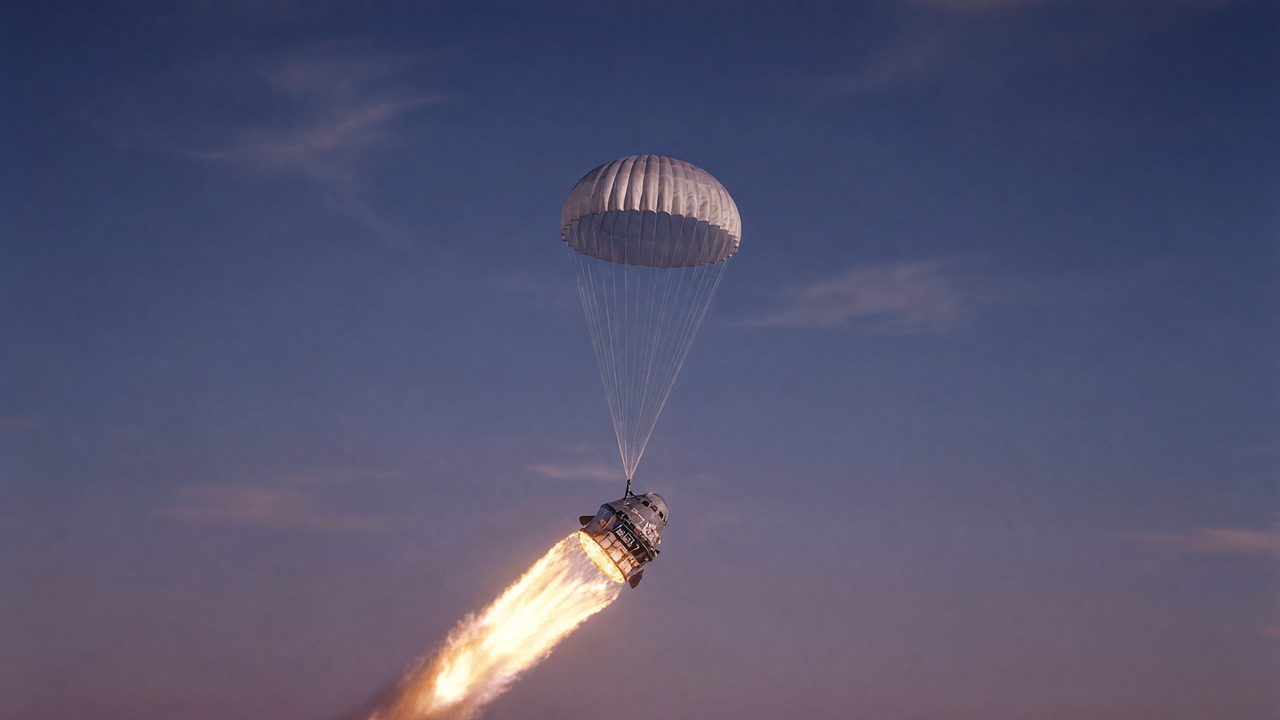
Reentry demanded equal attention. Cooper deployed the drogue parachute at about 24,000 feet and the main chute at 11,000 feet, then inflated the landing bag just before splashdown—each step executed under manual command. When Faith 7 struck the Pacific Ocean on May 16, it settled only four miles from the prime recovery vessel, USS Kearsarge. NASA recorded it as the most accurate Mercury landing achieved to date. A pilot who had been told, in effect, that machines would fly the ship home had instead flown it himself through reentry and recovery.
Mercury Ends, Gemini Waits
Cooper's splashdown ended Project Mercury. In just over two years, four astronauts had ridden one-man capsules into orbit and returned, each flight teaching engineers something new about launch vehicles, life support, tracking, and recovery. Faith 7 added the hardest lesson: even late in a successful program, multiple systems could fail at once, and only a trained aviator in the loop could salvage the mission.
That lesson cleared the path to Gemini. The next program would require rendezvous, docking, and spacewalks—tasks no autopilot of the early 1960s could perform alone. Cooper's flight demonstrated that keeping a skilled pilot at the center of the decision chain was not nostalgia; it was engineering necessity. The bridge from Mercury to Gemini was open.
Why it matters to you
Cooper's Faith 7 emergency is a case study in the same discipline every pilot trains today: aviate, navigate, communicate—except Cooper had to do all three while his automatic systems quit and his instruments lied. When a glass-cockpit alert disagrees with what you see, when an autopilot drops offline on approach, when multiple minor faults arrive together, the temptation is to chase the technology. Cooper oriented by the real horizon, prioritized flying the spacecraft, and communicated just enough to keep the ground informed without drowning in noise. That hierarchy—fly the machine first, verify what the sensors claim, use automation as a tool rather than an authority—runs through instrument training, partial-panel practice, and crew resource management in cockpits far removed from orbit. The legacy of Leroy Gordon Cooper, Jr. is not only a Mercury capsule in a museum. It is the enduring standard that when things begin to stack up, the human at the controls still has to land the ship.