When the Sky Refused Them Home
"The year 2003 had been anticipated as a centennial celebr..."
When the Sky Refused Them Home
On the morning America meant to celebrate a century of flight, Columbia fell from orbit—and the Columbia Accident Investigation Board would prove the disaster was waiting in plain sight.
A Centennial Year Opens in Grief
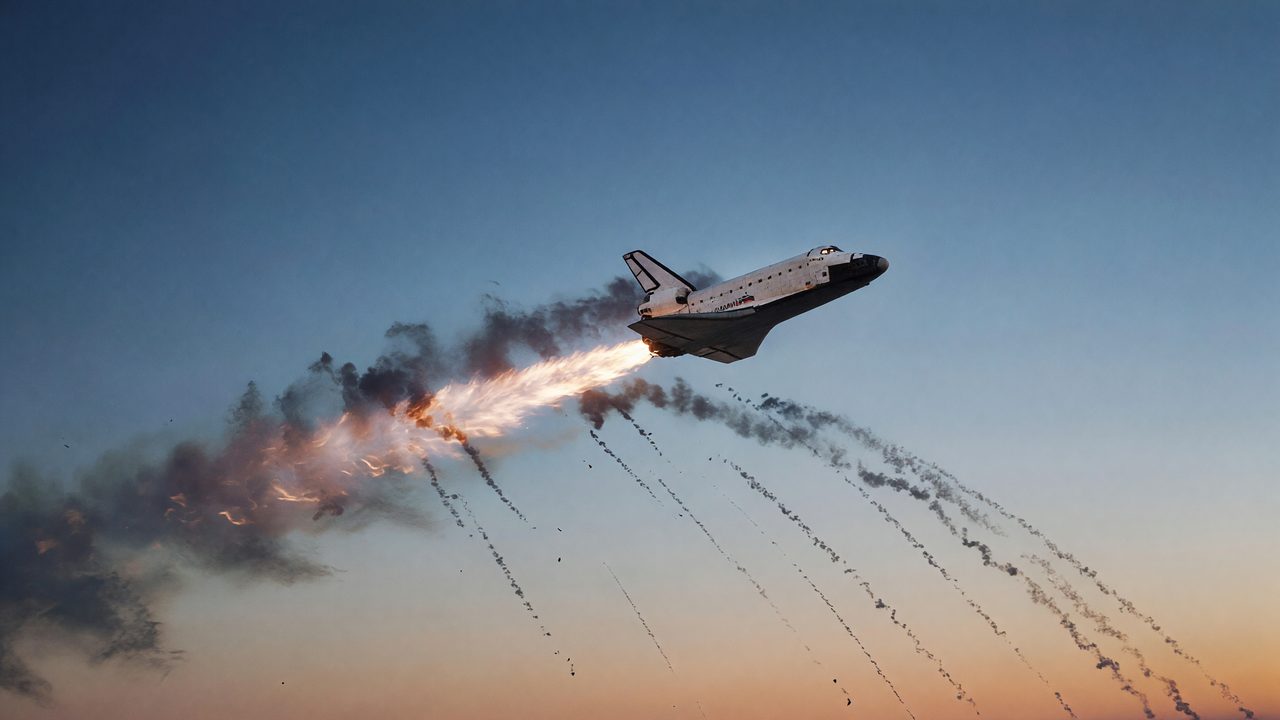
The year 2003 had been framed as a milestone: one hundred years since the Wright brothers’ first powered flight at Kitty Hawk. Instead, the nation awoke on 1 February to catastrophe. Space Shuttle Columbia—the orbiter that had inaugurated the shuttle era on STS-1 in April 1981, veteran of twenty-seven missions, and namesake of the Apollo 11 command module from the first Moon-landing mission—broke apart during reentry over Texas and Louisiana. Scheduled touchdown at Kennedy Space Center lay roughly sixteen minutes away when contact was lost.
Aboard were seven astronauts who had spent sixteen days in orbit conducting research: Commander Rick D. Husband, Pilot William C. McCool, Mission Specialists Michael P. Anderson, David M. Brown, Kalpana Chawla, and Laurel B. Clark, and Payload Specialist Ilan Ramon of the Israel Space Agency. Their mission, STS-107, had been a science flight—microgravity experiments in biology, materials, and combustion—carried out without a visit to the International Space Station. The crew had completed their work. Reentry was the final, familiar leg home.
The Strike Nobody Stopped
Within hours of the loss, NASA Administrator Sean O’Keefe appointed the Columbia Accident Investigation Board, chaired by retired U.S. Navy Admiral Harold W. Gehman Jr. The board’s mandate was uncompromising: determine what happened, why it happened, and what it revealed about the shuttle program and the agency itself.
The physical chain of events, as documented in the CAIB’s August 2003 Report: Volume One, began not in the Texas sky but eighty-two seconds after liftoff on 16 January. At that moment, a piece of insulating foam shed from the External Tank’s left bipod ramp and struck the reinforced carbon-carbon leading edge of the left wing. Video from launch had captured the impact; engineers debated its significance for days while the orbiter sailed on, unaware.
The strike breached Columbia’s Thermal Protection System. During reentry, when the orbiter plunged into the atmosphere at hypersonic speed, superheated plasma air worked through the damaged wing. Aluminum structure melted from within. Sensors registered rising temperatures. Aerodynamic loads that had been routine on dozens of prior entries became unbearable. The vehicle disintegrated.
An Accident with a History
The CAIB did not treat Columbia as a freak event. Its executive summary and full report—the same document preserved in NASA’s Technical Reports Server as citation 20030093634—concluded that the accident was “not random” but the product of organizational practices and expectations that had accumulated across decades of shuttle operations.
Foam shedding had been observed since the earliest flights. Each incident had been categorized, debated, and often accepted as within experience. The board found a culture in which schedule pressure and the assumption that nothing critical had yet failed could quietly normalize risk. Debris strikes to the thermal protection system were discussed; the possibility that one could destroy an orbiter was not acted upon with the urgency the physics demanded. Columbia, in the board’s framing, was lost to a failure of imagination as much as to a piece of foam.
Reform and the Question of Purpose
The CAIB issued sweeping recommendations: stronger independent safety oversight, redesigned External Tank foam application, improved imaging of the orbiter in flight, and a management culture that could hear dissent without punishing it. The shuttle fleet stood down for more than two years. When Discovery flew again in July 2005, the program operated under scrutiny the CAIB had demanded.
Columbia’s loss also reopened a national argument that predated the accident: what human spaceflight is for, what risks are acceptable, and who bears responsibility when ambition outruns evidence. The centennial year of powered flight became, instead, a year of reckoning—with engineering, with institutions, and with the gap between what pilots and crews are asked to trust and what organizations prove they have earned.
Why it matters to you
The legacy of STS-107 reaches into every cockpit where pilots train today. The CAIB’s central lesson was not merely that foam can kill—it was that normalized deviance erodes judgment long before metal fails. In commercial and general aviation, that same pattern appears when crews brief a hazard they have “seen before,” when maintenance deferrals stack up against schedule, or when a culture treats the absence of an accident as proof of safety. Modern crew resource management, safety management systems, and just-culture reporting all echo the board’s insistence that organizations must invite bad news upward and act on it before reentry, not after. The year 2003 was meant to honor a century of learning to fly; Columbia’s sacrifice reminds rated and student pilots alike that the hardest skill is not handling the aircraft—it is refusing to accept the unacceptable because nothing has gone wrong yet.